
Last updated September 10, 2026
Full 25-point door and opener safety check with every visit - springs, cables, rollers, tracks, and your LiftMaster or Chamberlain opener included
You get a price before we start. It does not change when the truck arrives.

 Before
 After
After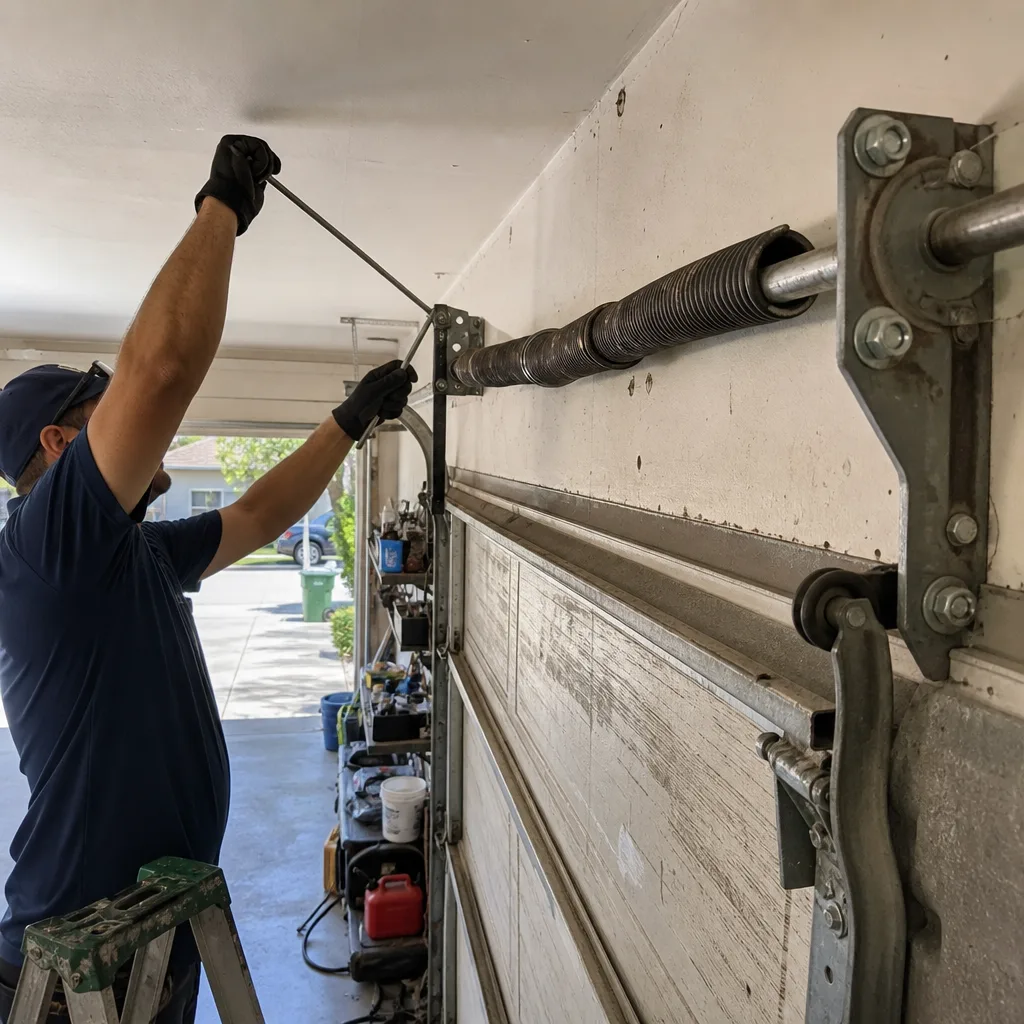 Before
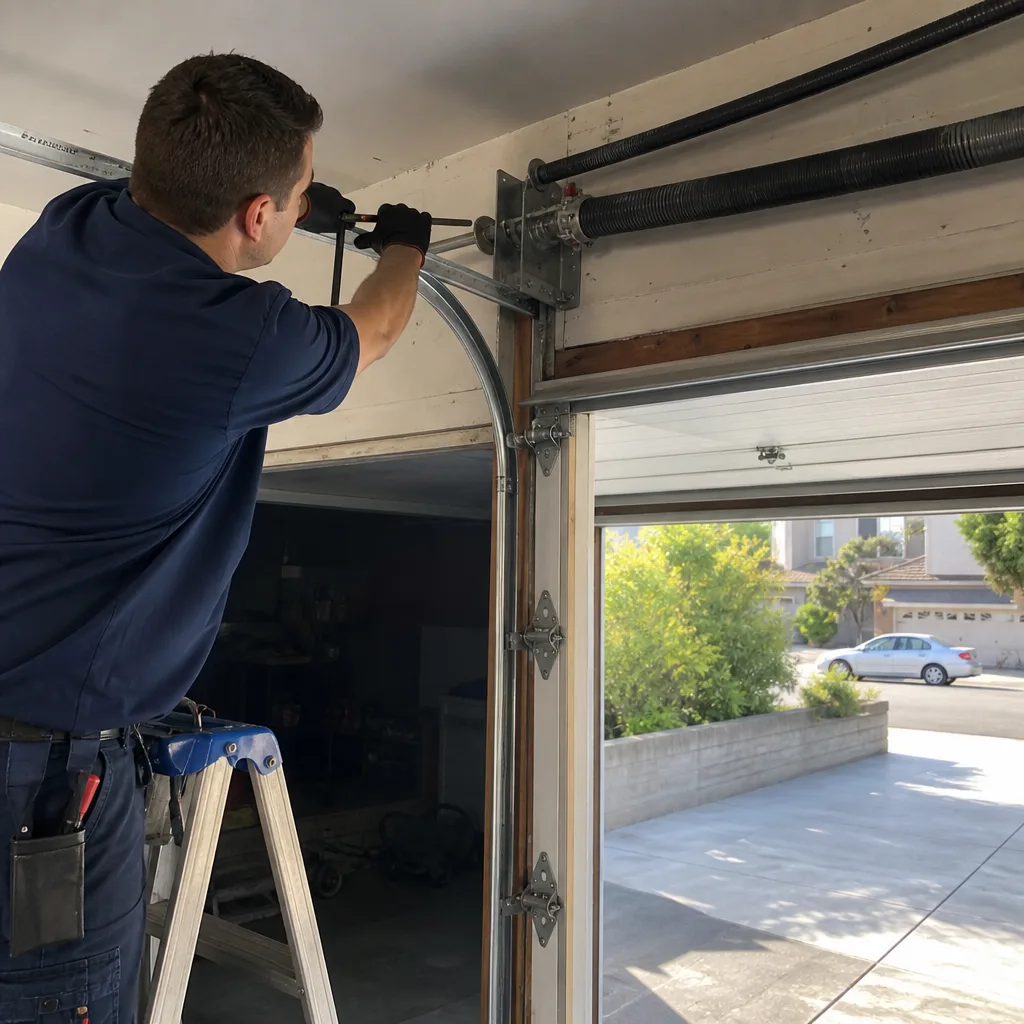 After
After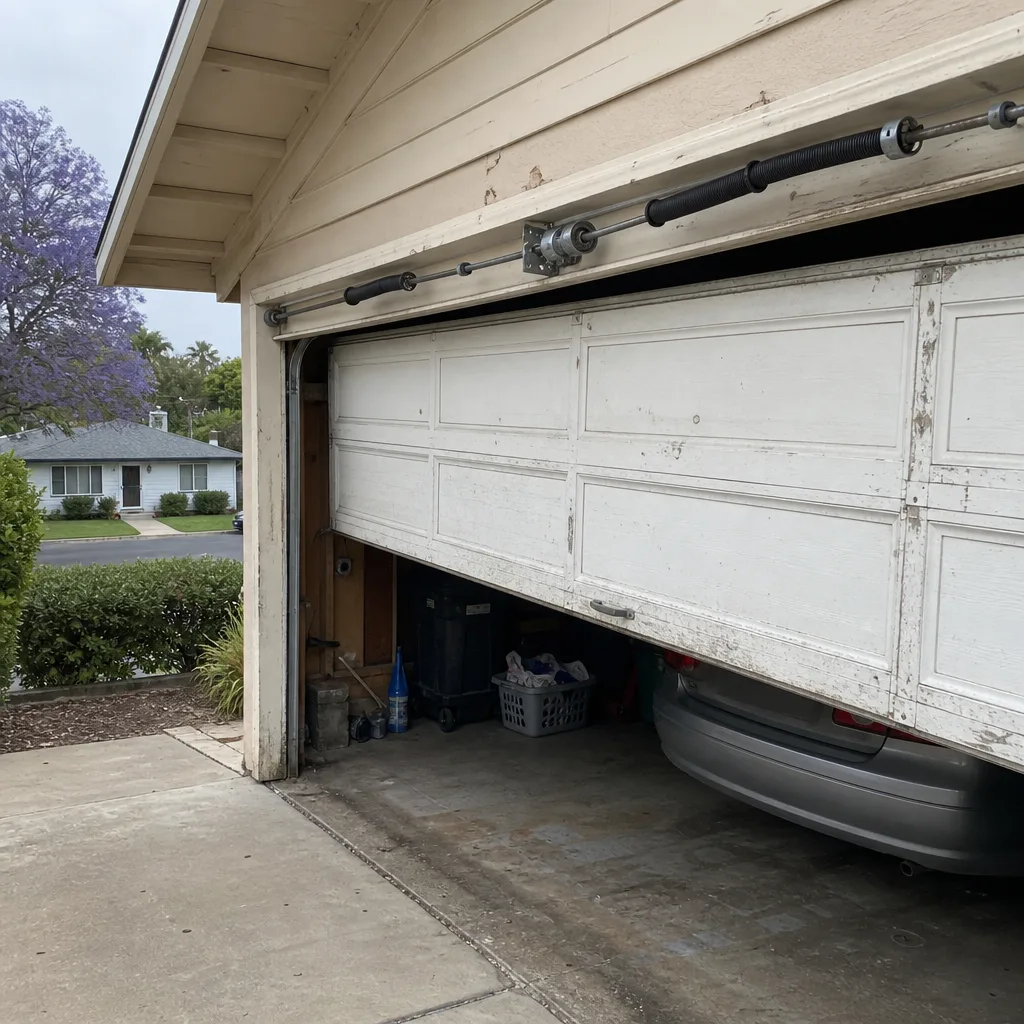 Before
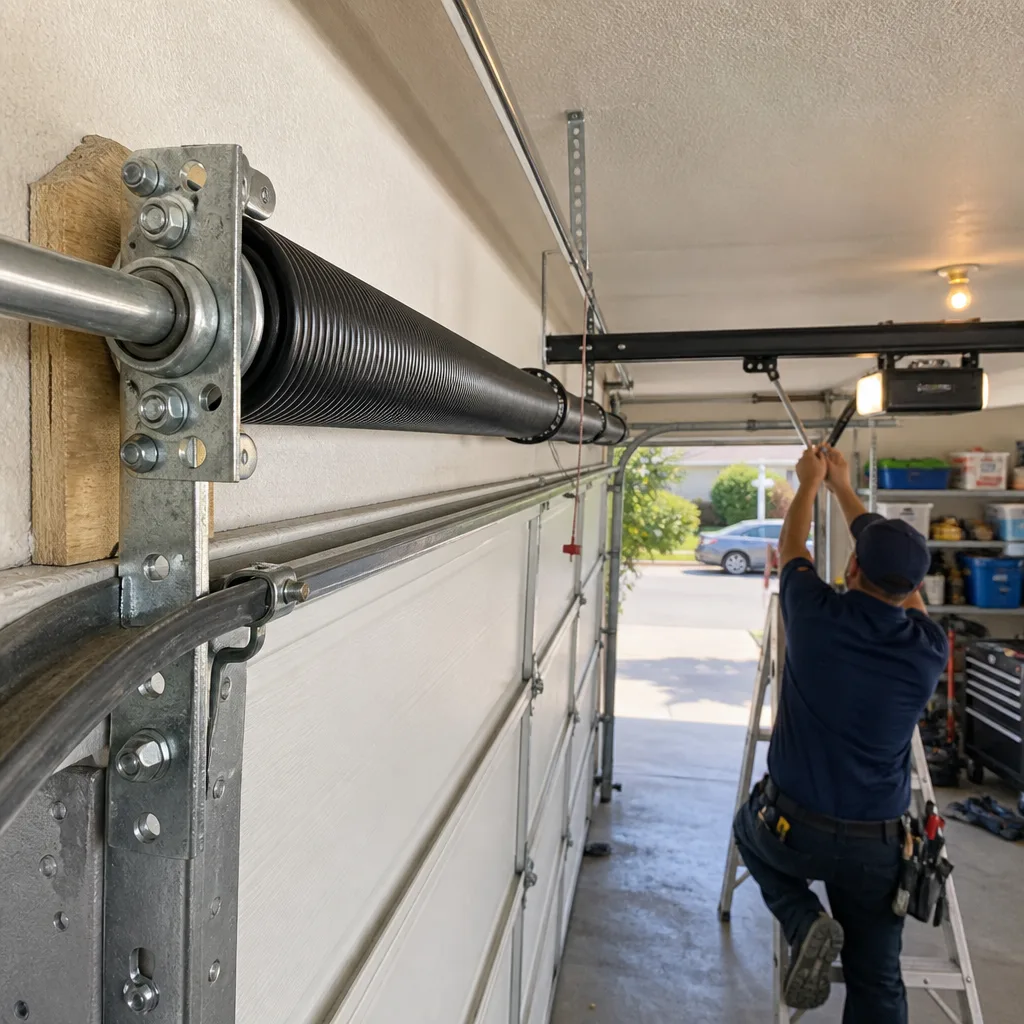 After
AfterGarage Door Warning Signs: A La Mesa Homeowner’s Reference Guide
The most dangerous thing a garage door does before it fails isn’t the loud bang. It’s the three weeks of “it’s a little slow in the morning” that people get used to right up until a torsion spring breaks at full tension while someone’s standing next to it. A residential garage door weighs between 150 and 250 pounds, and every single pound of that rides on two springs that have a finite number of cycles in them. Here in La Mesa, where summer heat bakes the metal and winter damp creeps into older wooden frames, doors talk to their owners constantly. Most people just haven’t been told what the sounds mean. This reference guide names each warning sign exactly, explains what’s breaking underneath it, and tells you whether it’s a watch-it or a call-today situation. By the end, you’ll know more about your garage door than most people know about their car’s brakes.
Quick Answer
Garage door warning signs in La Mesa fall into five categories: unusual sounds (grinding, popping, scraping), movement problems (slow, jerky, reversing), visible wear (frayed cables, rusted springs, sagging sections), balance issues (door drifts down or won’t stay up), and opener behavior (straining, short-cycling, phantom reversals). A door that’s merely noisy on a cool morning is usually a lubrication issue. A door that’s noisy, slow, and visibly sagging at one corner is a spring losing tension, and that’s a call-today problem because the failure mode is sudden and violent. When in doubt, a professional inspection costs less than a new door, and in La Mesa, Otto’s Garage Door offers free estimates at (619) 903-6668.
Table of Contents
- Noise Identification: What Grinding, Popping, and Scraping Actually Mean
- The Slow Door: Lubrication Problem or Failing Spring?
- Why Your Door Reverses Unexpectedly (And When It’s a Safety Code Failure)
- Reading Your Cables and Drums: Fraying vs. Normal Wear
- The Balance Test: How to Check Spring Health Without Touching Anything Dangerous
- La Mesa Binding: Seasonal Wood Movement vs. Track Problems
- Opener Straining: Why the Motor Is Almost Never the Problem
- Visual Warning Signs You Can Spot From the Driveway
Noise Identification: What Grinding, Popping, and Scraping Actually Mean
Every garage door makes some sound. That’s normal. What separates a healthy door from a failing one is the type of sound, when it happens, and whether it’s getting worse. In our experience across La Mesa, most homeowners wait until a noise becomes impossible to ignore before they call, and by then the cheap fix has become an expensive replacement. Here’s the mechanical translation guide we use when someone calls and tries to describe what they’re hearing over the phone.
Grinding is the sound of metal on metal with no lubrication between the surfaces. On a garage door, that almost always means the rollers are running dry inside the tracks. The fix is usually straightforward: clean the tracks, replace worn rollers, and lubricate properly. Where people get into trouble is waiting too long, because dry metal shaves off tiny particles every cycle, and those particles embed in the track and accelerate wear. In La Mesa’s dry climate, rollers lose lubrication faster than people expect, especially on south-facing garages that catch full afternoon sun.
Popping is different. A popping sound is a spring shifting, catching, or releasing tension in a sudden motion. Torsion springs are under enormous pressure, and when they pop, it’s the sound of that pressure finding a new position. This is a watch-it-closely sound if it happens once, and a call-today sound if it’s happening every time you operate the door. A popping spring is a spring telling you it wants to break. It doesn’t negotiate.
Scraping is almost always a track issue. The door edge is rubbing against a misaligned track, or the track itself has come loose from the wall and the door is dragging it. This is not subtle and it’s not normal. Scraping means something structural has moved, and continued operation is literally carving away material every cycle. What starts as a $90 roller-and-track adjustment becomes a warped door panel replacement if ignored long enough.
Here’s the quick reference in list form:
- Grinding = metal on metal, needs lubrication and likely new rollers. Fixable.
- Popping = spring shifting under tension. Watch closely, usually call today.
- Scraping = track or roller alignment problem. Won’t fix itself, gets worse fast.
- Squealing = high-pitched, usually hinges or bearing plates. Annoying but rarely dangerous.
- Rattling = loose hardware, easy fix if caught early.
- Thumping = door hitting something or panel separating. Investigate immediately.
The Slow Door: Lubrication Problem or Failing Spring?
This is the #1 misdiagnosed garage door problem in La Mesa, and honestly, we get it. A door that moves slowly in the morning and speeds up as the day warms looks like a lubrication issue. Sometimes it is. But the distinction matters more than you’d think, because the two causes require completely different responses.
Here’s the difference: a door that’s slow because it’s dry is slow evenly. It travels the whole track at a consistent, sluggish pace. It might make grinding or squeaking sounds. It’s been months or years since anyone touched the rollers, hinges, or bearings. The fix is a service call: clean tracks, replace rollers, lubricate everything, and the door speeds right back up.
A door that’s slow because a spring is losing tension is slow unevenly. It pauses or struggles at the bottom of the track, where gravity is working hardest against the weakened spring. It might move fine for the first few inches of travel, then bog down. The opener motor sounds like it’s working harder than it used to. And critically, the door feels heavy when you pull the emergency release and try to lift it by hand.
A door that feels heavy when you lift it manually is a spring problem, not a lubrication problem. That’s the single most reliable test a homeowner can perform without special tools. Disconnect the door from the opener with the release cord, then lift the door halfway by hand. A healthy door stays where you put it or drifts only slightly. A door with a failing spring drops or takes serious muscle to lift.
If you raise a door with a weak spring repeatedly, here’s what happens: the opener motor works harder on every cycle, running hotter, wearing out faster. And the spring keeps losing tension until, one day, it snaps. Not slowly. Not with a warning. It lets go all at once, and the full door weight drops onto whatever is underneath it. For a setup like that, you’ll want a professional from garage door repair in La Mesa to check it before it fails.
Why Your Door Reverses Unexpectedly (And When It’s a Safety Code Failure)
Since the early 1990s, every garage door opener sold in the United States has been required to include a photo-eye safety system: two small sensors mounted near the floor on either side of the opening that project an invisible beam. If the beam breaks while the door is closing, the door reverses. The system exists so a child or pet crossing the threshold triggers the door to back off instead of hitting them. It’s a federal safety requirement, and a door that doesn’t have a working safety reversal system is a code violation.
But here’s the part most La Mesa homeowners don’t know: there are three reasons a door reverses, and only one of them is sensor-related. Here they are, in order of how often we see them:
- Misaligned or dirty photo-eyes. The sensors have drifted slightly out of line, or dust and spider webs are breaking the beam intermittently. The door reverses mid-close as a false positive. This is the “sensor alignment annoyance.” It’s a quick fix.
- Excessive down-force sensitivity. The opener is set too sensitive. It feels resistance on the way down (like a tight roller or dry track) and decides something is in the way. The door reverses because the motor is being overly cautious. The deeper issue is usually mechanical drag, not the sensor.
- Travel limits out of adjustment or a failing logic board. The opener thinks the door has hit the ground when it hasn’t, or the control board is misreading signals. This is the one that makes people replace an opener that might have needed only a limit adjustment.
The important distinction: a door that reverses only when the beam is broken is working exactly as designed. A door that reverses randomly is telling you something is wrong, and the problem could be as small as a dirty sensor or as serious as a cracked gear. The safety question is whether the reversal system is functional at all. You can test it by placing a roll of paper towels in the door’s path and closing the door. If the door crushes the towel roll, the safety reversal is not working, and that’s a code failure that should be addressed immediately. For questions about specific opener behavior, see our garage door opener guide for La Mesa. Brands like LiftMaster and Genie all use the same basic photo-eye system, but the adjustment procedure varies slightly by model.
Reading Your Cables and Drums: Fraying vs. Normal Wear
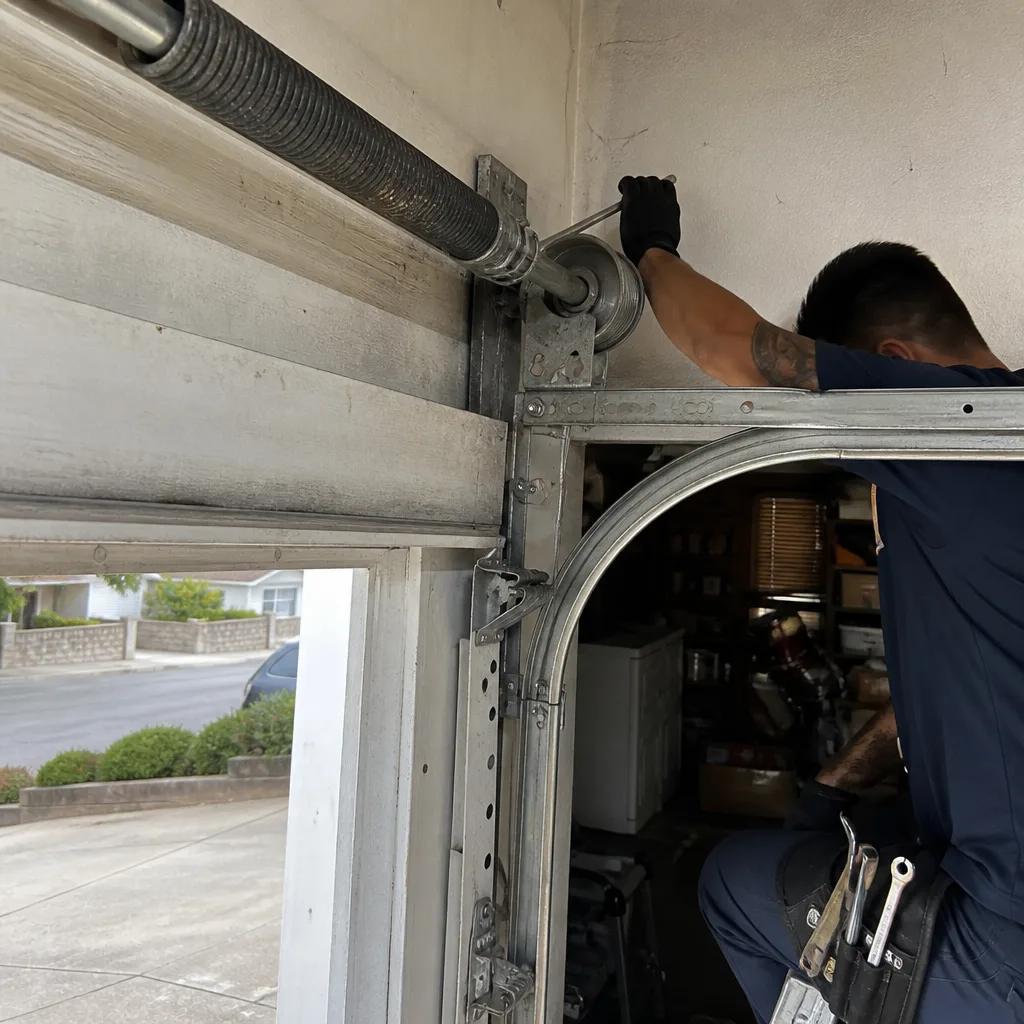
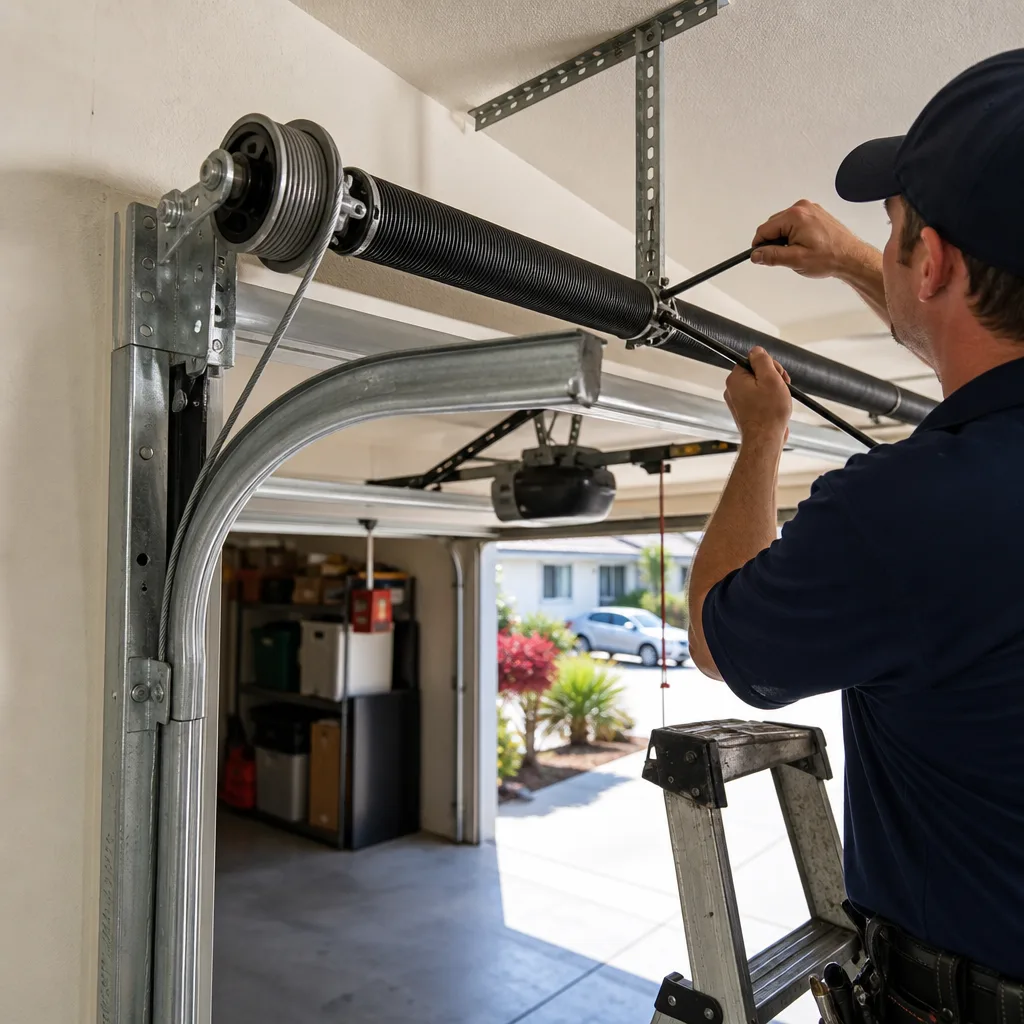
The cables on a torsion spring system are under the same tension as the springs themselves. They’re not cosmetic. A cable that snaps releases the full stored energy of the spring instantly, and the door becomes a falling object. The good news is that cables give clear visual warning before they fail, if you know what to look for.
Normal cable texture is smooth and uniform. A healthy cable looks like tightly wound wire rope, all the strands lying flat and parallel against each other. It’s shiny in spots where it rubs against the drum, but that shine is even and consistent.
Fraying looks different. Individual wire strands start separating from the main cable body. You’ll see little whiskers of wire sticking out, often near the drum where the cable winds and unwinds, or near the bottom bracket where the cable attaches to the door. Sometimes the fraying is hard to spot because it happens on the inside edge of the cable, facing the wall. Other signs: rust bleed on the cable (which means internal corrosion), flat spots where the cable has been crushed against the drum, or a cable that sits loose on the drum instead of winding tightly.
The drums themselves tell a story too. On a properly functioning door, the cable wraps evenly around the drum, each coil sitting neatly beside the next. If you see cable overlapping itself on the drum, or the drum has visible score marks, or the cable doesn’t wrap in a smooth spiral, the tension is uneven. Something has shifted. The door is no longer lifting evenly, even if it still seems to work.
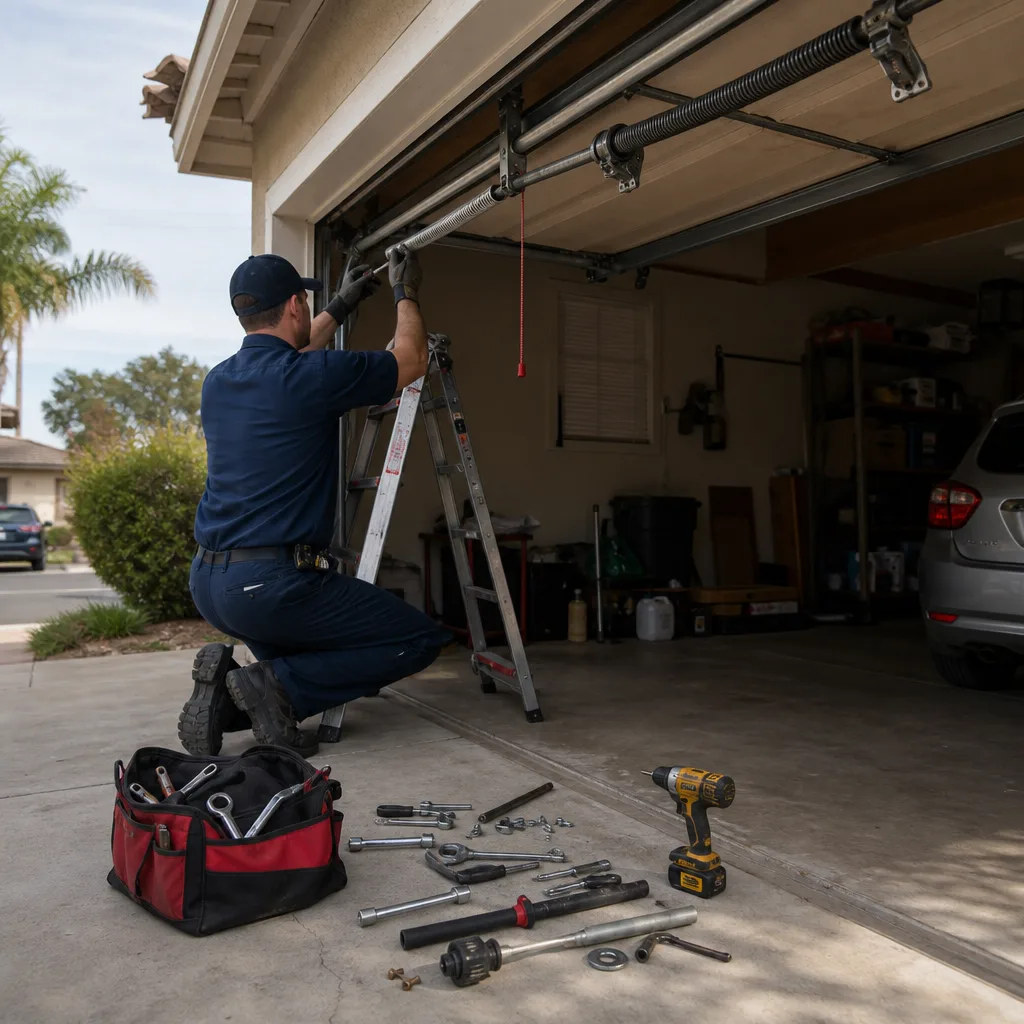
A safety note from someone who has been doing this since 2004: do not attempt to adjust, replace, or even touch the cables yourself. The energy stored in a torsion spring is enough to break bones or worse. Cable work is always a trained-professional job, no exceptions. A door is 200 pounds riding on two springs. Respect it. If you see fraying or uneven wrapping, call (619) 903-6668 and describe what you’re seeing. We’ll tell you honestly whether it can wait for a scheduled appointment.
The Balance Test: How to Check Spring Health Without Touching Anything Dangerous
The single most informative test for overall door health is the balance test, and any homeowner can do it safely in under two minutes. It doesn’t require touching springs, cables, or anything under tension. Here’s the step-by-step:
- Close the garage door completely.
- Pull the emergency release cord. This cord hangs from the opener rail, usually red. Pull toward the door, not sideways. You’ll hear or feel a click when it disengages.
- Manually lift the door using the handle or the bottom edge, keeping your fingers out of the track. Lift it to waist height. Use your legs, not your back. If the door is too heavy to lift at all, stop and call a professional. That’s your answer.
- Release the door at waist height. A properly balanced door will stay roughly where you left it, maybe drifting an inch or two either direction.
- Observe: if the door drifts downward more than a few inches, the springs are weak or failing. If it shoots upward, the springs are over-tensioned (usually from an incorrect repair by someone who didn’t know what they were doing). If it drops fast, the springs are essentially dead.
- When done, re-engage the opener by pulling the release cord toward the opener, then run the opener once to reconnect it.
In La Mesa, we see doors that live their whole lives in direct afternoon sun fail their balance test a full year before the springs actually snap. That year is the window. You can fix a weak spring on your schedule. You cannot schedule a broken spring. It schedules you, usually at 8 PM on a Sunday. If your door drifts or feels heavy, the fix now is a fraction of the drama later. For a full service check, our repair page covers what we inspect on every call.
La Mesa Binding: Seasonal Wood Movement vs. Track Problems
If your garage door seems to catch, stick, or bind at certain points in its travel, and you live in a La Mesa home built before about 1990, seasonal wood movement may be in play. Older homes in La Mesa neighborhoods like the Village, Helix, and Casa de Oro often have wood-framed garage openings. Wood expands and contracts with humidity. La Mesa may be dry most of the year, but we do get damp winters and heavy morning marine layer, and when that moisture gets into an aging wood frame, the frame can swell enough to make the door bind.
Here’s how to tell the difference between wood movement and a track alignment problem. Wood movement binding is seasonal. It’s worse in damp months and nearly gone in late summer. The door binds at a specific point in its travel, usually near the bottom or top, and the binding point moves slightly depending on how much the frame has swelled. You may see the door rubbing a polished or worn spot on the wood frame itself. The fix is usually a frame adjustment or shaving, not a track adjustment.
Track alignment problems don’t care about the season. The binding is consistent, day in and day out. You’ll often see a visible gap between the track and the door edge, or the track itself will be bent, dented, or loose where it anchors to the wall. Sometimes a track that’s set too tight from a past DIY adjustment will bind exactly the same way in August as it does in February.
Track adjustments look simple, and in some ways they are. The reason we caution against DIY track work is that the track isn’t just a guide. It’s the channel that contains a moving door under load. A track that’s adjusted incorrectly can allow the roller to climb out, and then the door partially leaves the track while moving. That’s a genuinely dangerous failure. The fix is usually a modest job when we catch it early. For installation-level questions, our installation guide has more on track specifications.
Opener Straining: Why the Motor Is Almost Never the Problem
When a garage door opener sounds labored, most people assume the motor is wearing out. In our experience, the motor is the culprit less than a quarter of the time. The opener is the easiest component to blame and the most commonly needlessly replaced. What’s actually happening is usually one of three things, all of which are fixable for a fraction of the cost of a new opener:
First, the door itself is heavy or imbalanced, and the opener is being asked to do the work the springs should be doing. Openers are designed to move a balanced door, not to lift an unbalanced one. If the springs are weak, the opener motor strains every cycle, gets hot, and burns out prematurely. This is the “problem behind the problem” we see most often in La Mesa.
Second, the opener gear or drive mechanism is worn. Chain drives stretch and wear sprockets. Belt drives crack with age. Screw drives wear their threads. This is mechanical wear and it’s real, but replacing the worn part is different from replacing the whole opener. On brands like LiftMaster, Chamberlain, and Genie, the gear kits and belt assemblies are replaceable for a fraction of the unit cost. Raynor openers have similar modular designs in their current lineup.
Third, the opener is genuinely undersized or old. A 1/4-horsepower opener from the 1990s moving a modern double-wide insulated door is working beyond its design. If the opener is 20 years old and the door is new, that’s a mismatch, and replacement makes sense. But if the opener is 7 years old and the door hasn’t been serviced since installation, the opener is probably fine. The door is what needs attention.
If the opener is straining, the problem is almost never the opener. That’s a heuristic that’s served us well since 2004. For more detail on specific opener brands and failure modes, our opener page covers the differences between LiftMaster, Chamberlain, Genie, and Raynor.
Visual Warning Signs You Can Spot From the Driveway
You don’t need to touch anything to spot a garage door problem. Some of the most useful warning signs are visible from six feet away, and a quick visual once-over every few months will catch most issues while they’re still cheap to fix. Here’s what to look for:
Sagging panels. A door that’s losing spring support will sometimes show a visible dip at the top corner or in the middle of the top section. The section itself is bending under load. This is a late-stage warning sign. When you see it, the spring has been weak for a while.
Uneven spacing at the top. Stand inside the garage and look at the gap between the top of the door and the header. It should be even left to right. If one side is higher than the other when the door is closed, the door is lifting unevenly. That’s a spring tension or cable drum problem.
Gaps at the bottom. A door that sits fully on one side and leaves a gap on the other isn’t just an energy issue. It’s a structural clue. The door, the floor, or the track has shifted. If the gap changes seasonally, it’s likely floor heave or wood movement. If it’s constant, get it looked at.
Rust on springs or hardware. Surface rust on a spring is cosmetic. Deep, flaking rust that covers a spring end to end is a different story. Rust weakens the metal and accelerates fatigue. In La Mesa’s summer heat and winter damp, a 7-year-old rusted spring is more likely to fail than a clean 10-year-old one.
Worn or cracked rollers. Nylon rollers should be smooth and round. If you see flat spots, cracks, or missing nylon with metal showing through, they’re done. Metal rollers with visible wear on the wheel surface are also done. Worn rollers cause grinding, binding, and uneven track wear. They’re cheap to replace if caught early.
We count spring cycles the way you count tire miles. I’ll tell you what’s left on yours. Most La Mesa homeowners are surprised to learn that a spring rated for 10,000 cycles can last anywhere from 7 to 12 years depending on how often the door opens. If you don’t know your spring’s age, a visual inspection tells us a lot.
Common Mistakes to Avoid
- Ignoring a slow door because “it still works.” Every week a slow door goes unaddressed is a week of accelerated spring fatigue. The failure, when it comes, will be sudden.
- Lubricating the wrong things, or the right things with the wrong product. WD-40 is a solvent, not a garage door lubricant. It strips the grease off the rail and dries out rollers. Use a silicone or lithium-based lubricant on moving parts, and nothing on the track itself except cleaning.
- Adjusting or replacing cables and springs yourself. The energy in a torsion spring is lethal. No homeowner should work on cables, springs, or anything inside the spring assembly. We’ve repaired more than one “I watched a YouTube video” job, and they’re always more expensive than if the homeowner had called first.
- Assuming the opener is the problem when the door is heavy. The opener is the messenger. The spring is the message. Replace the opener without fixing the spring, and you’ve spent $400 and solved nothing.
- Ignoring the photo-eyes because the door “works fine.” A working door with a broken safety reversal is a code violation and a liability. Test it once a month with a paper towel roll. It costs nothing.
- Waiting to address binding until the door comes off the track. Binding is the earliest warning of track misalignment. By the time a roller jumps the track, you’re looking at a much bigger repair, and possibly a damaged door panel.
- Deferring maintenance “until something breaks.” Garage doors are one of the few home systems where the scheduled maintenance costs less than 10% of the emergency repair. A $129 tune-up every couple of years beats an $800 emergency spring replacement at 9 PM.
When to Call a Professional
If your door makes any of the sounds in the noise guide above, fails the balance test, shows fraying cables or uneven drum wraps, or triggers the safety reversal test as a failure, call a professional. These are not diagnostic suggestions. They’re mechanical warnings with real consequences. A door that drops unexpectedly can damage a vehicle, injure a person, or trap a car inside the garage so you can’t get to work. The window between “I noticed something” and “it failed completely” is often shorter than people expect. Otto’s Garage Door offers free estimates in La Mesa. Call (619) 903-6668 and a real person answers, often Otto himself, and he’ll tell you over the phone whether you need someone today or can wait for a scheduled appointment. The name on the van is the name on the invoice and the name on the license. You’ll see him again at the hardware store, and he treats your door the way he’d treat his own.
Frequently Asked Questions
Most noise-related repairs in La Mesa run between $89 and $229, depending on whether you need roller replacement, lubrication, or hardware tightening. Grinding noises are usually the cheapest fixes. Popping sounds that require spring work run higher, typically $280 to $400 for a spring replacement including parts and labor. Call (619) 903-6668 for a free estimate on your specific door. The price quoted on the phone is the price at the door, no surprises.
For spring failures, cable snaps, and doors that won’t open, yes, same-day service is available in La Mesa. We carry the most common springs, cables, and rollers on the truck, and we answer the phone 24/7 because a garage door doesn’t fail on a schedule. Call (619) 903-6668 and we’ll tell you honestly when we can be there.
A clicking sound is usually the opener’s gear starting to slip, or a spring beginning to shift. You can often keep using the door for a short time, but we’d advise you to get it inspected. Clicking that gets louder or more frequent is a sign the underlying issue is progressing. If the clicking is accompanied by any jerking movement, call today. That’s the sound of something about to let go.
A quality torsion spring rated for 10,000 cycles typically lasts 8 to 12 years in La Mesa, depending on how often the door opens and whether the garage faces south or west. Doors that get direct afternoon sun run hotter and can fatigue springs faster. If your door is 10 years old and still on its original springs, you’re on borrowed time. A visual inspection will tell us how much life is left.
Stop using the door immediately. Do not try to force it up or down. Disconnect the opener using the emergency release, and call (619) 903-6668. A door that’s off the track is unstable and can fall without warning. We’ll likely be able to re-seat it and adjust the track the same day, and we’ll check the entire system while we’re there to make sure it doesn’t happen again.
Yes. We work on LiftMaster, Chamberlain, Genie, Raynor, and every other major brand. Parts availability varies by brand, but the mechanical principles are the same across all residential doors. If you have a specific brand you’re worried about, call us and we’ll tell you what we stock and what we’d need to order.
The Bottom Line
Garage doors are predictable machines. They don’t fail by surprise; they fail by neglect, usually after weeks or months of warning signs that went unread. The noises, the slowness, the sagging, the fraying cables, and the behavior of your opener are all information. Most of the time, the fix is cheaper than the replacement, and the replacement is cheaper than the damage from a failure. If you live in La Mesa and it’s been more than a couple of years since someone looked at your door, call Otto’s Garage Door at (619) 903-6668 for a free estimate. I will be there myself, and I’ll tell you what’s fine, what’s marginal, and what needs work today. No pressure, no upsell, no price changes at the door. The name on the van is the name on the invoice and the name on the license, and a door is 200 pounds riding on two springs. Respect it.
Written by Otto Reinhardt, Owner at Otto’s Garage Door, serving La Mesa since 2004.